
 Hourly · 8 min read
Coordinating an As-Directed Chauffeur Itinerary
Coordinate an as-directed chauffeur itinerary with one approver, exact next-stop instructions, passenger and luggage updates, and a confirmed final return.
Read article→Coordinate chauffeur travel for Long Island estate guests with a host-side arrivals sheet, private access instructions, luggage planning and staggered departures.
MOE
Oct 30, 2026

Agree the estate entrance and guest handoff before the journey.
A private estate visit can look simple on a map: collect a guest, reach an address and return later. The practical work sits between those points. Which driveway should the car use? Who can confirm the guest is expected? Where can the party safely meet, and will everyone leave together? For Long Island chauffeur travel, those details deserve the same attention as the date and vehicle choice.
This guide focuses on coordinating arrivals and departures at coastal residences, private venues and estate settings. It is useful for hosts, household staff, executive assistants and guests arranging a visit. It does not establish access rights to a property or promise that a particular vehicle, route or service is available; those arrangements need confirmation for the individual booking.
Ask the host or authorised property contact for the complete address and the entrance intended for the visit. A house name, estate name or map pin may be useful context, but it should not be the sole pickup or destination instruction. If there is more than one entrance, confirm which is for guests and whether a different one is used for departures.
Keep the questions practical. Does the property contact expect the car to enter, or is the agreed meeting point elsewhere? Who should be contacted if the entrance cannot be identified? Is the guest expected to meet the car at a particular location? Do not send a chauffeur through a gate simply because a previous visitor used it. Equally, do not invent a gate procedure for a property that has none.
Access codes, private contact details and a guest list should go only through the agreed channel to the people who need them. Ordinary journey coordination should not require circulating a household's full schedule or forwarding unrelated personal documents. Identify the contact who can clarify access on the day, and make sure the traveller can reach them.
Swipe to compare all columns →
| Detail to settle | Confirm with | Useful instruction for the journey |
|---|---|---|
| Full address and intended entrance | Host or authorised property contact | The guest approach for this specific visit |
| Permission and expected arrival | Host or property contact | Who is expected and whom to contact if clarification is needed |
| Practical vehicle meeting point | Property contact and transport team | The agreed location for loading or unloading passengers and bags |
| Return readiness | Lead traveller or organiser | Who reports that the party is ready to leave |
| Change approval | Booking contact | One person authorised to request a revised itinerary |
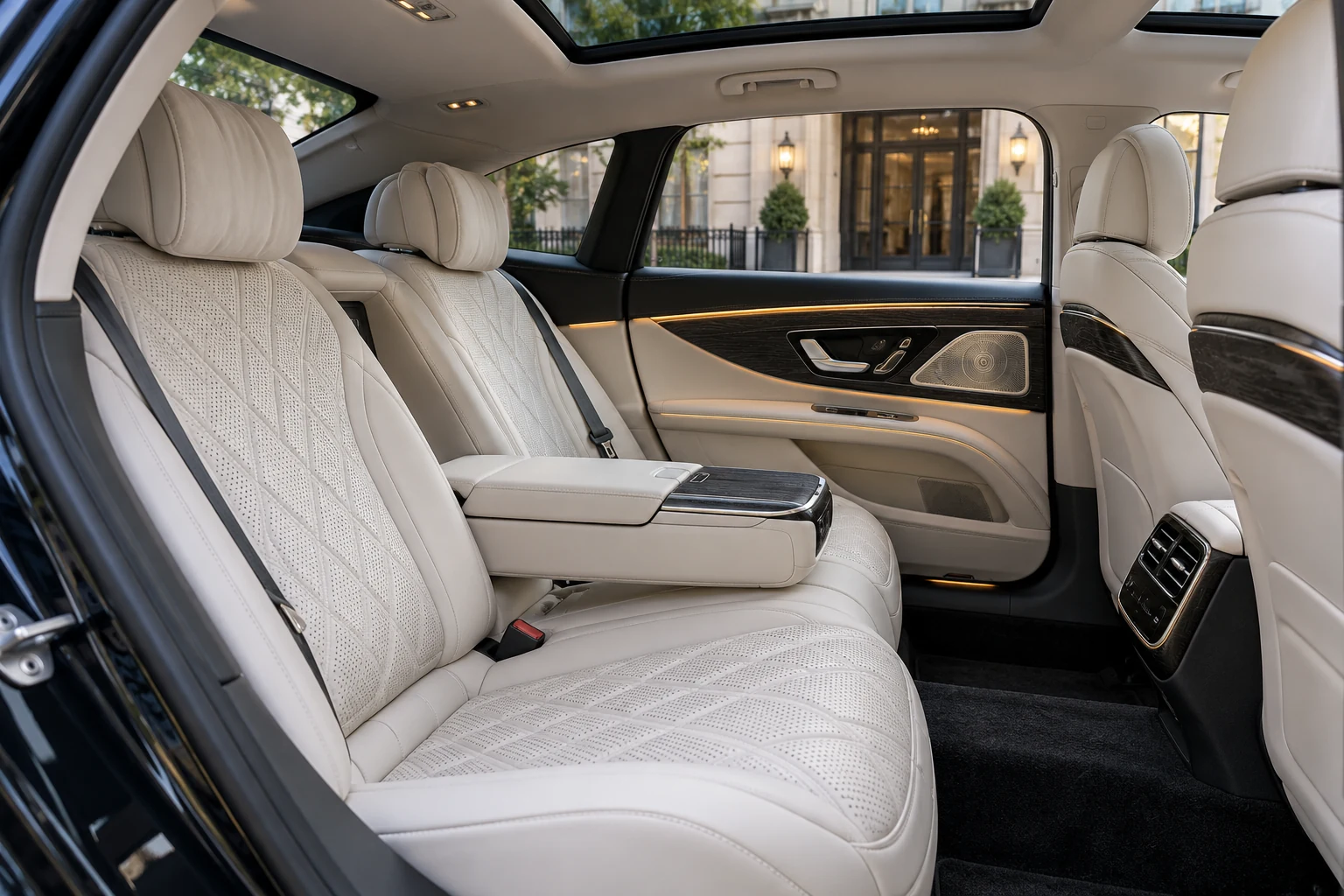
A chauffeur reservation does not by itself establish permission to enter a private driveway, use a loading area or wait on the property. Ask the host to confirm those arrangements, then ask the transport team to review the practical meeting instructions. If the proposed location is unsuitable on the day, agree an alternative with the relevant contacts rather than telling guests to wait at an assumed stopping point.
For an organised gathering, the host should also establish any venue, parking and event requirements that apply. Southampton's official FAQs explain that several types of event permits may be relevant and direct organisers to the responsible departments. They also warn that parking which inhibits emergency access can create a safety issue. This is a reason for the organiser to confirm the actual event plan, not a claim that every household visit requires the same permit or that one town's arrangements apply across Long Island.
Do not treat a public roadside area as reserved waiting space without confirmation. A host's parking plan and the car's booked waiting time answer different questions. Tell the transport team whether the property has supplied a meeting instruction, and ask how that fits the proposed service. Never assume that an event invitation authorises traffic control or guarantees a space for a vehicle.
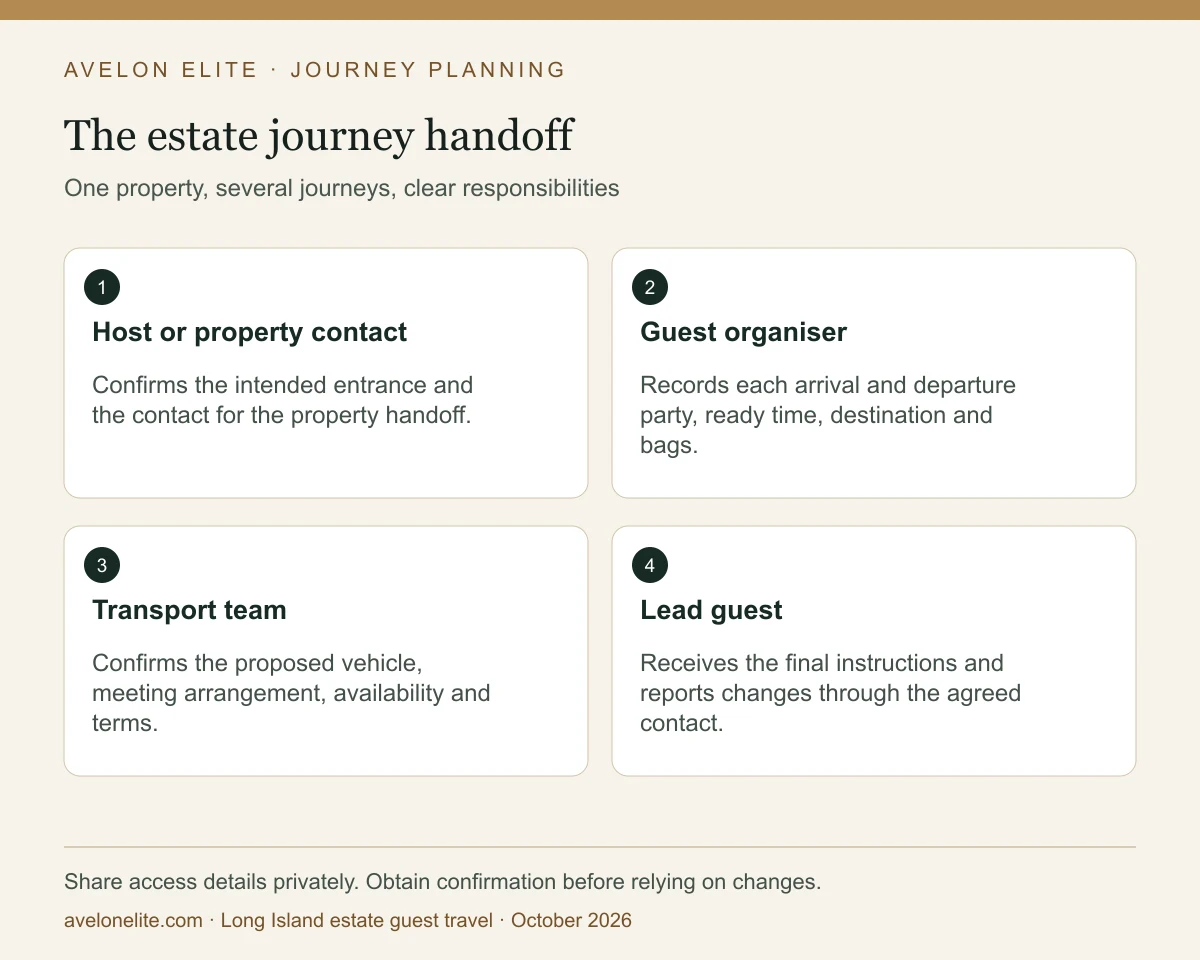
A dinner, weekend stay or private event may have one destination but several transport movements. A couple arriving from a hotel, relatives coming from a residence and guests leaving for different places should each be identifiable in the working itinerary. Use one row per movement, with the party and luggage for that leg.
Swipe to compare all columns →
| Movement | Record before confirming | Avoid this assumption |
|---|---|---|
| Arrival from one address | Origin, ready-to-leave time, guest party, luggage, lead contact and estate handoff | That the host's address alone identifies the correct handoff |
| Guests joining later | Their origin, ready time, arrival target, party, bags and lead contact | That the first booking automatically covers another collection |
| Early departure group | Who leaves, ready time, bags, destination, lead contact and confirmed handoff | That every guest returns in the same car or at the same time |
| Uncertain finish | Expected finish window and the agreed update process | That a return reservation is open-ended waiting |
| Several return stops | Addresses in order and the party on each leg | That additional destinations are included without review |
Four guests travel together to a dinner. Two intend to leave earlier for a hotel, while two return later to a home. The outward vehicle request and each return need their own clear brief. Ask the transport team to confirm the arrangement available for those movements; do not tell guests that a single outward confirmation settles every departure.
Give the lead traveller only the final agreed instructions for their movement. One time-stamped itinerary is easier to follow than an email chain containing several proposed pickup times. If the plan changes, identify the affected journey, revised party and new address or time in one message.
Send a short message for each departure group once the transport team has confirmed it. A useful template is:
Your confirmed collection is [date and time] at [agreed meeting point]. The booked movement is for [party] with [confirmed luggage] to [destination]. Please be ready at [time or agreed readiness process]. Your journey contact is [name and agreed contact channel]. If your party, bags or destination changes, contact [booking coordinator] before relying on a revised arrangement.
Use this only after replacing the brackets with the confirmed details. Do not include a reusable gate code in a message distributed to an entire event list. The host should decide how private access information is shared with the people who need it.
“Long Island” is not a precise collection area or a reliable travel-time estimate. A North Shore visit and a South Fork visit need their own addresses, arrival targets and return plans. Do not copy a proposal for one property into another booking and assume the route, timing or quote will remain suitable.
For example, the Town of Huntington describes Huntington Bay in relation to Huntington Harbor and Northport Bay, while Southampton lists Water Mill among its hamlet planning pages. These municipal references establish local context; neither provides a chauffeur journey time to your particular destination.
For a longer journey beginning at a Huntington Bay address, use the Huntington Bay long-distance planning guide. For the departure-to-city handoff from Water Mill, see Water Mill to Manhattan travel planning. This article instead addresses the host, entrance and guest-movement coordination at an estate setting.
Check current travel conditions close to the date. NYSDOT's Travel Center directs travellers to 511NY for traffic and travel information throughout the state. Treat that information as a planning input and review the proposal when circumstances change. It does not turn a map estimate into an arrival guarantee. If anyone proposes a ferry connection or other timed transfer, establish its current schedule and booking conditions with the relevant operator before building it into the car itinerary.
Count guests and luggage together. Avelon Elite's offered limits below exclude the chauffeur and refer to typical suitcases. Suitcase dimensions, mobility equipment, pushchairs and other unusual items require a separate suitability check.
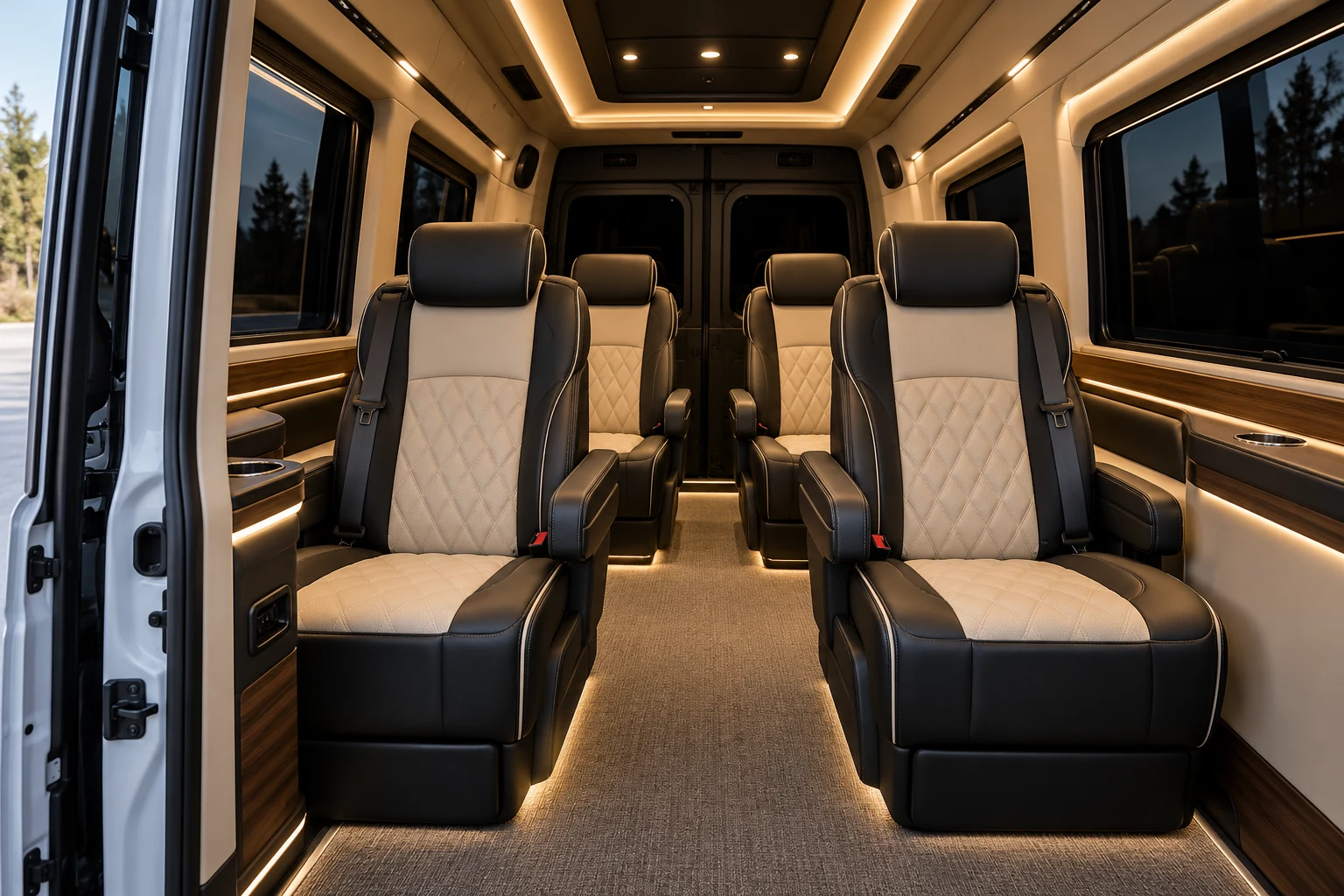
The offered 2026 Mercedes-Benz EQS limit is three passengers and two typical suitcases; the 2026 Cadillac Escalade IQL limit is five passengers and five typical suitcases; and the 2026 Mercedes-Benz Sprinter limit is six passengers and four typical suitcases. These passenger counts exclude the chauffeur.
Two guests with two typical cases can begin with a sedan enquiry. Four guests should not select the offered EQS configuration. Six guests with six large cases should not assume that the Sprinter's six-passenger allowance covers their luggage too. Describe what will travel on each leg and ask the team to confirm an appropriate arrangement.
Tell the booking team about essential seating, assistance or equipment needs early. A vehicle image does not confirm its assigned interior, exact configuration or availability for the date. A larger vehicle can also prompt practical access questions at a property, so pass on the host's actual meeting instructions rather than making assumptions from the vehicle's appearance.
A point-to-point request, separate return transfers and an itinerary that includes time between stops are different arrangements. For a longer journey, review the city-to-city service; where time at locations and several movements need discussion, consider an hourly itinerary. Ask what the proposed booking covers rather than relying on the service label.
Review pickup and destination details, booked duration where relevant, stops, waiting terms, cancellation and amendments. Ask how tolls, parking, gratuity or additional time are treated in the quote. This guide gives no fixed rate, distance allowance or universal waiting period. Use the written proposal for your actual itinerary.
Swipe to compare all columns →
| Requested change | Who provides the detail? | What must be confirmed? |
|---|---|---|
| Different entrance or property meeting point | Host or authorised property contact | The current instruction and a practical handoff reviewed with the transport team |
| Later departure | Lead traveller through the booking coordinator | Availability, revised timing and any effect on waiting or price |
| Extra guest or more luggage | Guest organiser | The complete party and load fit the proposed vehicle arrangement |
| Different return destination or extra stop | Booking coordinator | The new address, sequence and any revised booking scope or price |
Nominate one person to approve revisions. The host can supply a changed entrance instruction, while the booking contact confirms any effect on the journey's scope. If a guest adds a stop or changes the return time, pass the complete revised requirement to the transport team and obtain confirmation before presenting it as settled.
No access should be assumed from the transport booking alone. Obtain the host's instructions for the particular visit and share the relevant details through the agreed channel. Ask who can clarify the handoff if the expected entrance is unavailable.
Only the expressly confirmed arrangement should be expected. Discuss whether you need separate transfers or time between movements, and review the waiting location, booked period and additional-time terms where applicable.
The host or event organiser should confirm the property and relevant local requirements with the responsible authority. The transport team needs the agreed pickup and drop-off instructions. A car reservation does not establish a venue permit or reserve public road space.
List each party, departure time, luggage load and destination as a separate requirement. Ask the booking team to confirm the arrangement available before assuming one vehicle or one reservation covers all movements.
No. Use exact addresses, required arrival times and current conditions for the individual proposal. Leave time for the guest's own handoff or preparation needs after the car arrives.
Provide the date, addresses, intended entrances if known, passenger and luggage counts, fixed commitments and return requirements. Identify what the host has confirmed and which details remain open. This gives the team a useful basis for reviewing availability and the proposed scope.
Plan your Long Island journey with the guest movements and property instructions ready. For a more involved estate visit or several departures, send the complete itinerary for review before booking.
Avelon Elite Chauffeur Dispatch
From executive airport arrivals at JFK, LGA, and EWR to private tarmac transfers at Teterboro (TEB), our white-glove chauffeurs ensure seamless, punctual transit.
More from the Blog
Hourly · 8 min readCoordinate an as-directed chauffeur itinerary with one approver, exact next-stop instructions, passenger and luggage updates, and a confirmed final return.
Read article→ Hourly · 8 min read
Plan a New York shopping itinerary with store appointments, entrance details, purchases and luggage, clear pickup updates and a confirmed journey home.
Read article→ Hourly · 8 min read
Plan hourly chauffeur travel in New York around the booked start, time at stops, final return and extra-time terms. Use a practical time ledger.
Read article→