
 Hourly · 8 min read
A Private Chauffeur for a New York Retail Itinerary
Plan a New York shopping itinerary with store appointments, entrance details, purchases and luggage, clear pickup updates and a confirmed journey home.
Read article→Coordinate an as-directed chauffeur itinerary with one approver, exact next-stop instructions, passenger and luggage updates, and a confirmed final return.
MOE
Nov 5, 2026

Give one current next-leg instruction and confirm the resulting movement.
An assistant names the next office, a passenger suggests a lunch stop and someone else sends a different entrance pin. Each message may make sense alone, but together they leave an important question unanswered: which instruction is the current one?
When requesting an as-directed chauffeur service in New York, agree how the next movement will be chosen and confirmed. This guide focuses on that handoff: one decision contact, a precise destination, the people and bags travelling, and an acknowledgement that distinguishes a proposal from the agreed plan. The booking confirmation defines the actual service and the process for changes.
Before the journey, identify who may give the next-destination instruction and who may approve a change affecting the booking. They may be the same person. An assistant outside the vehicle may approve the itinerary while a lead traveller reports that everyone is ready. Ask the booking team how those instructions should reach the journey contact.
This is a suggested division of responsibilities, not a substitute for the provider's confirmed process. Avoid asking several people to issue parallel directions. If a different colleague takes over, make the handover explicit rather than adding another voice to the conversation.
Agree the decision roles before departure
Swipe to compare all columns →
| Role | Useful responsibility | Boundary to clarify |
|---|---|---|
| Booking approver | Reviews a requested change to the destination, party or scope. | Who can accept any revised arrangement or price? |
| Lead traveller | Reports readiness and the actual next-leg party and bags. | Can this person change the itinerary, or only report its status? |
| Journey contact | Receives the instruction through the agreed channel. | Who will confirm the resulting movement and practical collection point? |
For a day of fixed business appointments, keep the roadshow meeting sheet as the background plan. The next-leg message should identify the current movement, not reproduce the entire schedule every time.
Choosing the next stop does not establish that every possible destination is included. Ask how the proposed as-directed arrangement will handle stops whose sequence is flexible, addresses still awaiting confirmation and requests outside the original brief. A label such as "as directed" does not confirm unlimited travel, additional stops or free changes.
When sending an update, say what changed and what remains the same. A corrected entrance at the same building is different from a new destination. Even a small-looking change can affect the workable pickup or route; have it reviewed through the agreed process.
Describe the request before treating it as the next instruction
Swipe to compare all columns →
| Request | What to send | What needs checking |
|---|---|---|
| Proceed to a stop already in the agreed itinerary | The stop reference, address, party and readiness update. | The current collection and destination instructions. |
| Use a different entrance at the same address | The precise entrance and the source of the revised instruction. | A practical vehicle meeting or drop-off point. |
| Add or replace a destination | The complete new address and the stop it replaces, if any. | Availability, booking scope and any revised terms. |
| Change the order of stops | The revised sequence and any fixed commitment affected. | Whether the new sequence is workable and confirmed. |

A venue name or map pin alone can leave the required entrance unclear. Send the full street address, the building or venue name where useful, and the entrance instruction obtained from the destination contact. Label a pin as supporting information and check that it agrees with the written address.
A compact next-leg message
Swipe to compare all columns →
| Field | Include |
|---|---|
| Movement | Which collection and next stop this message concerns. |
| Destination | Full address and the relevant building or venue name. |
| Entrance | The confirmed guest entrance or a clearly labelled unresolved question. |
| Readiness | Whether the party is assembled, or when an update will follow. |
| Party and load | Passengers, suitcases and additional items for this leg. |
| Revision | Which earlier instruction is replaced and whose approval is needed. |
For example, a message template could read: "Next movement: [collection point] to [full address]. Use [entrance confirmed by the host]. [Party and bags] are [readiness status]. This replaces [earlier instruction]. Please review the change and confirm the resulting collection and destination." Replace every bracket with real information before sending it.
Keep proposed details visibly unresolved. "Entrance to be confirmed" is more useful than presenting a guessed entrance as settled. Share logistical information through the agreed channel without adding confidential meeting documents or unrelated passenger information.
A colleague joining after lunch changes the passenger brief even if the destination stays the same. A suitcase collected from a hotel changes the load. Update both before relying on the arrangement for the next movement; do not assume the original outward counts still apply.
Avelon Elite's offered 2026 configurations, excluding the chauffeur, are Mercedes-Benz EQS: 3 passengers and 2 typical suitcases; Cadillac Escalade IQL: 5 passengers and 5 typical suitcases; and Mercedes-Benz Sprinter: 6 passengers and 4 typical suitcases. Describe cabin bags and unusual dimensions separately so the actual load can be reviewed.
A fourth passenger should not be added to an EQS movement on the assumption that a spare place exists. Ask the team to review an appropriate arrangement. For several travellers meeting from different locations, the group assembly guide covers readiness and meeting points in more detail.
A useful working record separates three states: the request was sent, it was received for review, and the resulting movement was confirmed. Agree what confirmation looks like with the booking team. A read receipt, a passenger's suggestion or a venue's entrance email does not settle a changed transport arrangement by itself.
Check the acknowledgement against the request. Does it name the intended destination, relevant entrance and affected movement? If the collection point differs from the lobby exit, ensure the traveller receives that distinction. Where instructions conflict, ask for one current version rather than leaving the driver and passengers to reconcile separate message threads.
Destination choice and practical routing are also different decisions. The traveller can explain the destination and arrival requirement; the route must remain workable for the vehicle and conditions. NYSDOT's Travel Center links to 511NY for traffic and travel information. A live map or an earlier estimate does not guarantee the duration of the next leg.
A preferred entrance does not reserve its curb. NYC DOT's parking summary prohibits waiting under No Parking, No Standing and No Stopping restrictions; its summary permits passenger pickup under the first two categories, but not No Stopping. Posted signs and other applicable restrictions govern the actual location. Confirm a practical meeting point instead of directing the vehicle to wait at an assumed entrance.
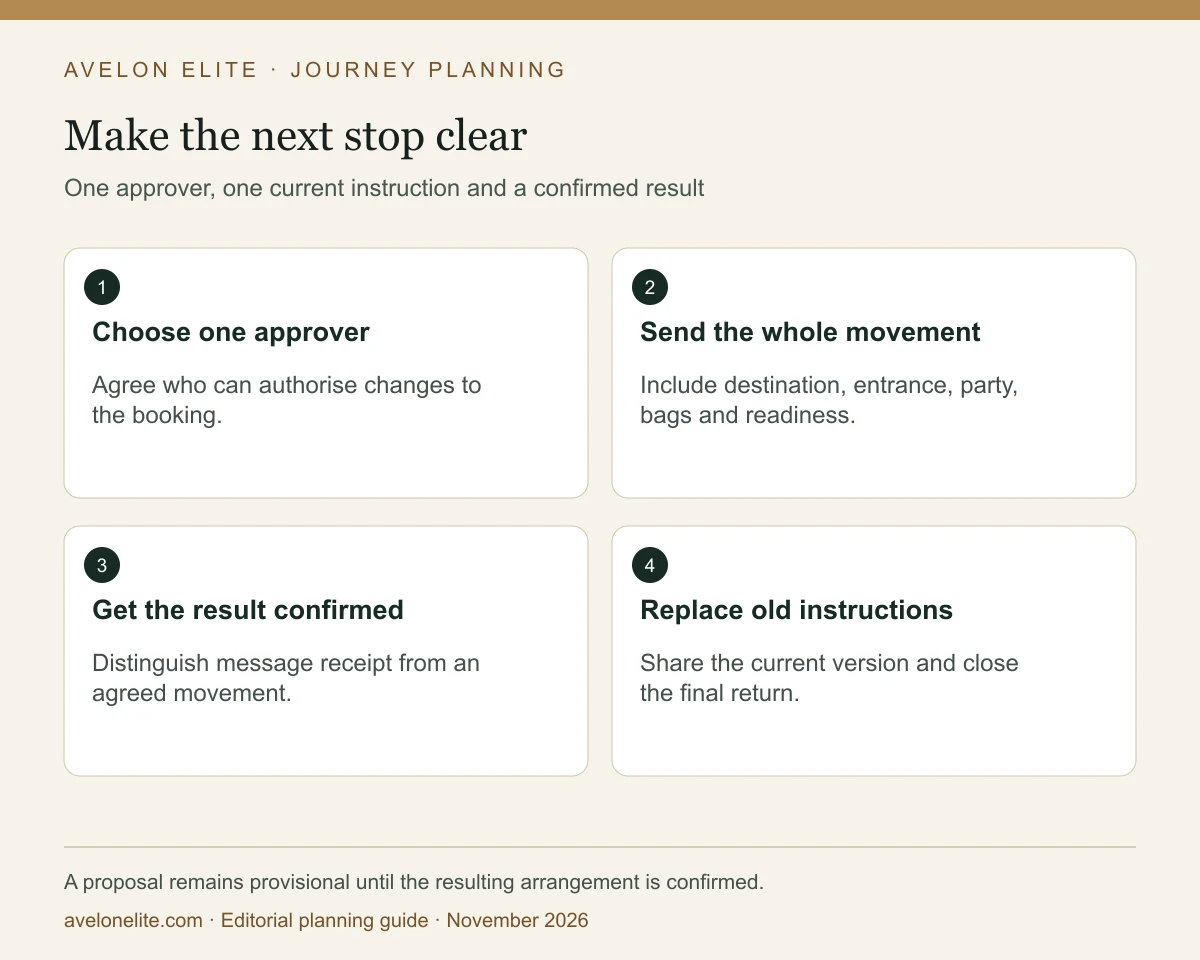
Choose one approver: Agree who can authorise changes to the booking. Send the whole movement: Include destination, entrance, party, bags and readiness. Get the result confirmed: Distinguish message receipt from an agreed movement. Replace old instructions: Share the current version and close the final return.
When the last appointment changes, update the return instruction too. Name the collection address, final destination, returning party and bags, and identify any remaining stop. "Take us back" is ambiguous if guests began at different hotels or someone collected belongings along the way.
Ask the journey contact to confirm the final movement through the agreed process. Send the resulting instructions to the traveller and withdraw the superseded version. The hourly booking time guide explains start and end conditions; this final handoff establishes where this party actually needs to go. Discuss the overall arrangement through the hourly chauffeur service enquiry.
Agree who gives the operative instruction and who can approve changes. Other passengers can raise requests, but the resulting movement should be confirmed through one agreed process.
Send the written address and relevant entrance as well. Check that the pin supports the same location, and identify any access instruction still awaiting confirmation.
No. Ask for review of the request and confirmation of the resulting arrangement, including any change to scope or price. Receipt alone leaves that decision unresolved.
Update the passenger and luggage counts for that leg. Have the proposed configuration reviewed before assuming the original vehicle arrangement still fits.
Do not assume so. Confirm the agreed destinations, change process and applicable terms. A new address, stop or return requirement may need a revised arrangement.
Plan your chauffeur itinerary with the next-stop decision process in mind, or send the proposed movements for review when the sequence or final destination remains unsettled.
Avelon Elite Chauffeur Dispatch
From executive airport arrivals at JFK, LGA, and EWR to private tarmac transfers at Teterboro (TEB), our white-glove chauffeurs ensure seamless, punctual transit.
More from the Blog
Hourly · 8 min readPlan a New York shopping itinerary with store appointments, entrance details, purchases and luggage, clear pickup updates and a confirmed journey home.
Read article→ Hourly · 8 min read
Plan hourly chauffeur travel in New York around the booked start, time at stops, final return and extra-time terms. Use a practical time ledger.
Read article→ Fleet · 7 min read
Plan New York group chauffeur travel with clear meeting points, passenger and luggage counts, a lead traveller and a realistic plan for changes.
Read article→