
 Hourly · 8 min read
Coordinating an As-Directed Chauffeur Itinerary
Coordinate an as-directed chauffeur itinerary with one approver, exact next-stop instructions, passenger and luggage updates, and a confirmed final return.
Read article→Coordinate a New York financial roadshow with a complete meeting itinerary, practical pickup instructions, suitable fleet capacity and clear booking terms.
Avelon Elite Editorial
Oct 25, 2026

Business travel in the 2026 Mercedes-Benz EQS
Key takeaways: Treat the roadshow as one coordinated schedule. Record each meeting, entrance and transition; distinguish fixed commitments from flexible ones and give one coordinator authority to approve changes.
A financial roadshow is a sequence of meetings, not a collection of unrelated car rides. The transport plan needs to connect each appointment, identify who can change the schedule and leave room for reception, security and boarding. For an executive assistant planning corporate car service in NYC, the most useful starting point is a complete itinerary with confirmed entrances and realistic transition time.
This guide focuses on coordinating a multi-stop business day. For passenger communication and onboard expectations, see our executive chauffeur protocol guide.
Give every stop its own row: meeting start, expected finish, full address, entrance, host contact and passenger count. Mark which appointments are fixed and which can move. Add the hotel pickup and final destination, even when the last meeting is still being confirmed.
Keep this working sheet separate from confidential presentation material. The transport team needs logistical instructions, not investor names, financial documents or the substance of the meetings. Share a coordinator’s contact and only the passenger information needed for the journey.

Use the table as a checklist for each appointment. Fill it with the organiser's confirmed information, not guessed travel times or confidential meeting content. A time-stamped version makes it easier to tell whether the transport team is working from the current plan.
Swipe to compare all columns →
| Field | What to record | Planning purpose |
|---|---|---|
| Appointment | Start, expected finish and whether either can move | Identifies the next fixed commitment |
| Building | Full address, guest entrance and host access instructions | Separates street arrival from meeting readiness |
| Transition | Expected ready-to-leave update and agreed pickup point | Includes movement from meeting room to car |
| Party | Passengers and bags/equipment for that leg | Captures guests joining or leaving |
| Change authority | Coordinator and agreed contact channel | Prevents conflicting instructions |
Before finalising the order, ask which meetings have genuine flexibility. Put that information beside the route rather than trying to improve geographic order after invitations are fixed. If a delay threatens a later appointment, the coordinator needs to decide which commitment can change; the driver should not be expected to solve a meeting-priority decision while driving.
When hosts offer flexible times, consider arranging nearby meetings together before committing to the sequence. A day moving between Lower Manhattan and Midtown needs a different plan from several appointments in the same building. Geographic order can help, but it should not override a confirmed meeting time or a host’s access instructions.
Avoid treating a map estimate as a guaranteed journey time. Check the relevant date window in NYC DOT's Weekly Traffic Advisory and its Special Traffic Advisories. The weekly list covers planned restrictions and can change; special guidance also addresses unscheduled security or emergency restrictions. Use 511NY for reported conditions. These sources help review the plan; they do not confirm access to a particular entrance or guarantee an arrival time.
The meeting address may not be the most useful vehicle entrance. Ask the host which entrance visitors should use, whether identification or advance registration is required, and where the passenger can meet the chauffeur afterward. Record the answer rather than assuming that every building handles visitors in the same way.
Plan a transition allowance that covers the whole movement: meeting room to lobby, lobby to vehicle, drive, then the next building’s arrival process. Choose that allowance with the organiser and the transport team. There is no single reliable number for every Manhattan appointment.
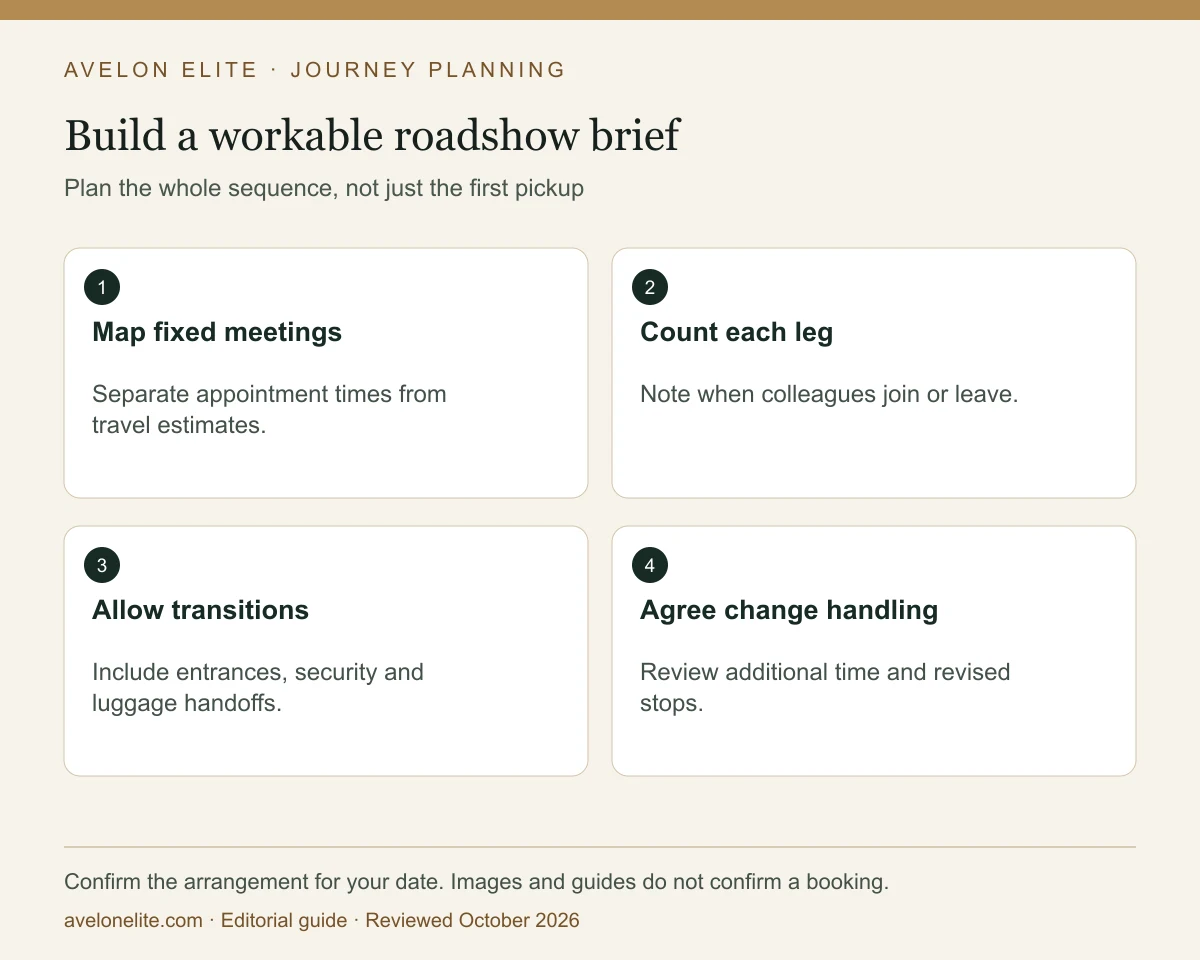
Map fixed meetings: Separate appointment times from travel estimates. Count each leg: Note when colleagues join or leave. Allow transitions: Include entrances, security and luggage handoffs. Agree change handling: Review additional time and revised stops.
Count everyone travelling and describe luggage, presentation cases and other equipment. Avelon Elite’s booking limits exclude the chauffeur:
Describe oversized items and any changes in the party before confirmation. A larger passenger group does not automatically leave more room for bags. Ask the team to confirm the available vehicle and suitability for the complete itinerary.
For a sequence of appointments, discuss hourly chauffeur service alongside the corporate travel request. Explain the expected duration of each meeting and whether the same vehicle is needed afterward. Do not assume a single-transfer booking includes a car waiting between meetings.
Before accepting the arrangement, confirm the booked duration, extra-time pricing, waiting terms, additional stops, parking, tolls and any other stated charges. Provide the company’s billing requirements and ask how the invoice will describe the service. Use the confirmed quote for budgeting rather than an unrelated advertised journey price.

Nominate one person to approve itinerary changes and keep a numbered or time-stamped version of the meeting sheet. If an appointment runs late, send the revised expected departure and the next fixed commitment. A clear update gives the transport team useful information to review availability and routing.
Before the day starts, confirm the communication channel and how the passenger will receive pickup instructions. Ask about essential amenities in advance; do not assume a vehicle provides a particular connection, charging cable or private working environment.
Executive travel management for multiple meetings involves deciding which commitments can change, not simply passing on the latest delay. Keep the remaining appointments visible together. A revised departure from one meeting can affect the next host, an optional stop and the final destination in different ways.
Ask the organiser to separate protected appointments from flexible meetings and optional catch-ups. Record who can approve a change and obtain the relevant host's agreement where a meeting time is affected. A chauffeur can review a proposed movement; they cannot decide which business commitment has priority or promise that an incompatible schedule can be recovered.
Swipe to compare all columns →
| Conflict in the remaining day | Organiser's decision | Transport requirement to review |
|---|---|---|
| An earlier meeting overruns a later fixed commitment | Ask the next host whether a revised appointment is acceptable; do not assume agreement | Revised passenger-ready time, entrance and confirmed arrival commitment |
| An optional stop competes with the final destination | Decide whether to omit, shorten or rearrange that appointment | Agreed remaining stop sequence and the final movement |
| A new meeting creates incompatible commitments | Resolve which appointment takes priority before issuing transport instructions | One agreed revised itinerary, including any changed party or belongings |
Hypothetical planning example: an opening meeting runs over, the next host has a protected appointment, and an informal catch-up is still on the sheet. The organiser should check the protected meeting with its host and decide what happens to the catch-up. Only then should the revised sequence be sent for transport review. Removing an optional stop does not itself establish a safe arrival time or an entitlement to extra booked time.
Issue one current version of the remaining day plan. Identify the changed appointment, the next protected commitment, the decision-maker, the agreed stops and the final destination. Mark the superseded version clearly. For communicating the resulting movement, use the next-stop instruction checklist; for duration boundaries and extension questions, see the hourly chauffeur planning guide.
Ready to coordinate the route? Plan your business journey, or send the meeting itinerary to Avelon Elite for review. Include the date, stops, passengers and luggage so the team can confirm the proposed arrangement.
Swipe to compare all columns →
| Question | Useful answer to obtain |
|---|---|
| Does the booking cover the time between meetings? | The booked period and waiting/extra-time terms, not just drive legs |
| How are additional stops approved? | One contact, a communication channel and any revised scope or price |
| What if a visitor joins for one leg? | Updated passenger/luggage counts and suitable vehicle arrangement |
| Which charges appear separately? | The quote's treatment of parking, tolls and other stated costs |
Not always. Discuss the complete day and compare separate transfers with an arrangement that includes time between appointments. Do not assume either option covers waiting or additional stops without confirmation.
Include building exit, pickup, driving and next-building access. Agree the allowance for the actual route and day; there is no universal transition time for every Manhattan meeting.
Ordinary transport coordination needs route, timing, passenger and contact details. Keep confidential presentation content separate and share only the information required to carry out the journey.
Our offered EQS limit is three passengers excluding the chauffeur, with two typical suitcases. For four executives, discuss the Escalade IQL or another suitable arrangement and provide the full luggage/equipment brief.
Review the remaining fixed commitments, ask affected hosts about any revised appointment and have the organiser decide which flexible or optional stop can change. Send one updated itinerary for transport review, and check whether the revised plan changes the booked time or price.
Avelon Elite Chauffeur Dispatch
From executive airport arrivals at JFK, LGA, and EWR to private tarmac transfers at Teterboro (TEB), our white-glove chauffeurs ensure seamless, punctual transit.
More from the Blog
Hourly · 8 min readCoordinate an as-directed chauffeur itinerary with one approver, exact next-stop instructions, passenger and luggage updates, and a confirmed final return.
Read article→ Hourly · 8 min read
Plan a New York shopping itinerary with store appointments, entrance details, purchases and luggage, clear pickup updates and a confirmed journey home.
Read article→ Hourly · 8 min read
Plan hourly chauffeur travel in New York around the booked start, time at stops, final return and extra-time terms. Use a practical time ledger.
Read article→