
 Hourly · 8 min read
Coordinating an As-Directed Chauffeur Itinerary
Coordinate an as-directed chauffeur itinerary with one approver, exact next-stop instructions, passenger and luggage updates, and a confirmed final return.
Read article→Plan corporate chauffeur travel in New York with a clear itinerary, useful communication, suitable vehicle preferences and confirmed booking terms.
Avelon Elite Editorial
Oct 25, 2026
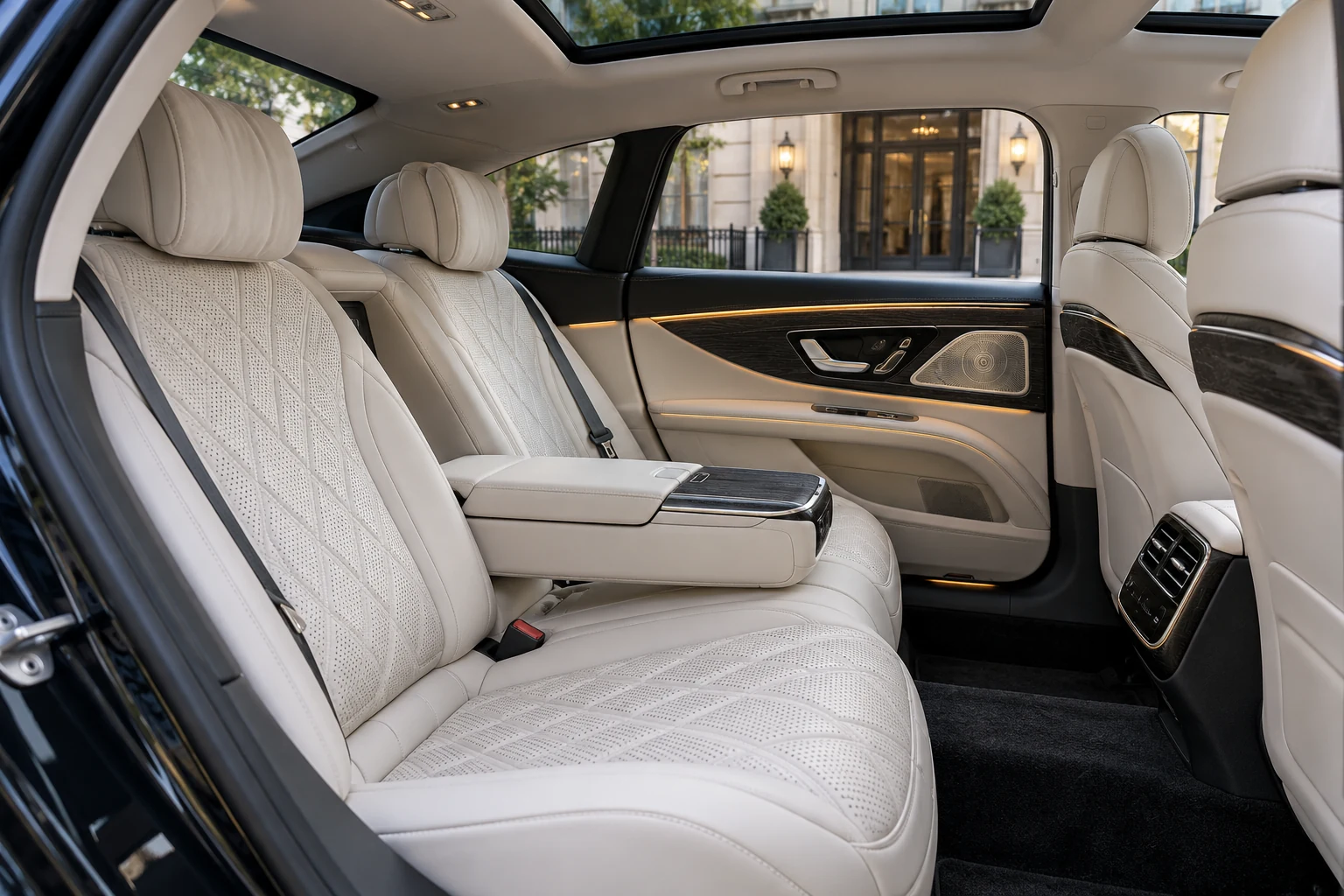
Mercedes-Benz EQS passenger cabin. Trim and seating configuration are confirmed before booking.
Key takeaways: Provide one complete itinerary, one change-approval contact and the full passenger/luggage brief. Keep pickup instructions current and confirm the scope, price and essential amenities before the day begins. Use the ride for work you can pause and schedule sensitive conversations in a private room.
A corporate chauffeur journey works best when the travel details are clear before the first pickup. For an executive assistant, office manager or traveller, good protocol means agreeing on the route, keeping communication useful and knowing which arrangements still need confirmation. It is a practical way to support a working day without treating every car journey as a separate task.
This guide explains what to include when arranging corporate chauffeur travel in New York, how to coordinate changes and what to check before confirming the booking.
Send the pickup address, destination, date and requested time together. Include the building entrance or reception point when the street address alone is not enough. If the passenger has several meetings, list the stops in their intended order and identify the commitments that cannot move.
A single transfer and a car requested between appointments have different requirements. Describe the full day, including the expected duration of stops, rather than assuming that a point-to-point booking includes waiting or additional journeys. For a flexible sequence, discuss an hourly chauffeur itinerary and ask how changes are priced.

Name the person who can approve changes. That might be the traveller, an assistant or an event coordinator. Give the booking team a suitable contact for the journey and explain whether the passenger should receive updates directly. Share only the information needed to arrange the trip.
If an airport arrival is involved, provide the flight number and travel date. Ask the operator to confirm the meeting point, waiting arrangements and what happens if the flight changes. Do not assume that every service includes the same flight monitoring or waiting allowance.
A vehicle preference is useful only when it reflects who and what will travel. Include the number of passengers, the number and size of bags, and any equipment that needs space. A group going directly to a presentation may bring more than ordinary overnight luggage.
The Avelon Elite website presents a 2026 Mercedes-Benz EQS electric sedan, a 2026 Cadillac Escalade IQL electric SUV and a 2026 Mercedes-Benz Sprinter executive van. Ask the team to confirm availability, the assigned configuration and its suitability for the party. Our booking limits, excluding the chauffeur, are 3 passengers and 2 typical suitcases for the EQS, 5 passengers and 5 typical suitcases for the Escalade IQL, and 6 passengers and 4 typical suitcases for the Sprinter. Describe oversized bags or equipment before booking so the team can confirm suitability.
Good protocol makes responsibilities visible. An assistant can maintain the meeting sheet while the traveller reports readiness to leave; the transport team then reviews any requested change. This example is a coordination aid, not a claim that a particular service or response time is included.
Swipe to compare all columns →
| Stage | Coordinator or traveller | What to confirm with the transport team |
|---|---|---|
| Before booking | Supply all stops, firm commitments, party and bags | Suitable service, vehicle arrangement, price and terms |
| Before the travel day | Check entrances, lead contact and current itinerary version | Final pickup instructions and update channel |
| If a meeting changes | State the revised ready time and next fixed commitment | Effect on route, waiting, availability and quoted scope |
| At pickup | Follow the agreed meeting instructions and report any difficulty | Where to meet if the planned point is not workable |
| After the journey | Keep the reference and provide correct billing information | Invoice details or a factual query about the service |
For time-sensitive work, avoid instructions such as “leave after the meeting” without an update process. State who will report the expected ready-to-leave time. Keep the chauffeur focused on driving and use the agreed contact route for non-urgent itinerary administration.
NYC311's car-service guidance describes these as prearranged journeys and advises checking fares and toll requirements with the base. A clear written scope is therefore part of practical booking protocol, not an optional courtesy.
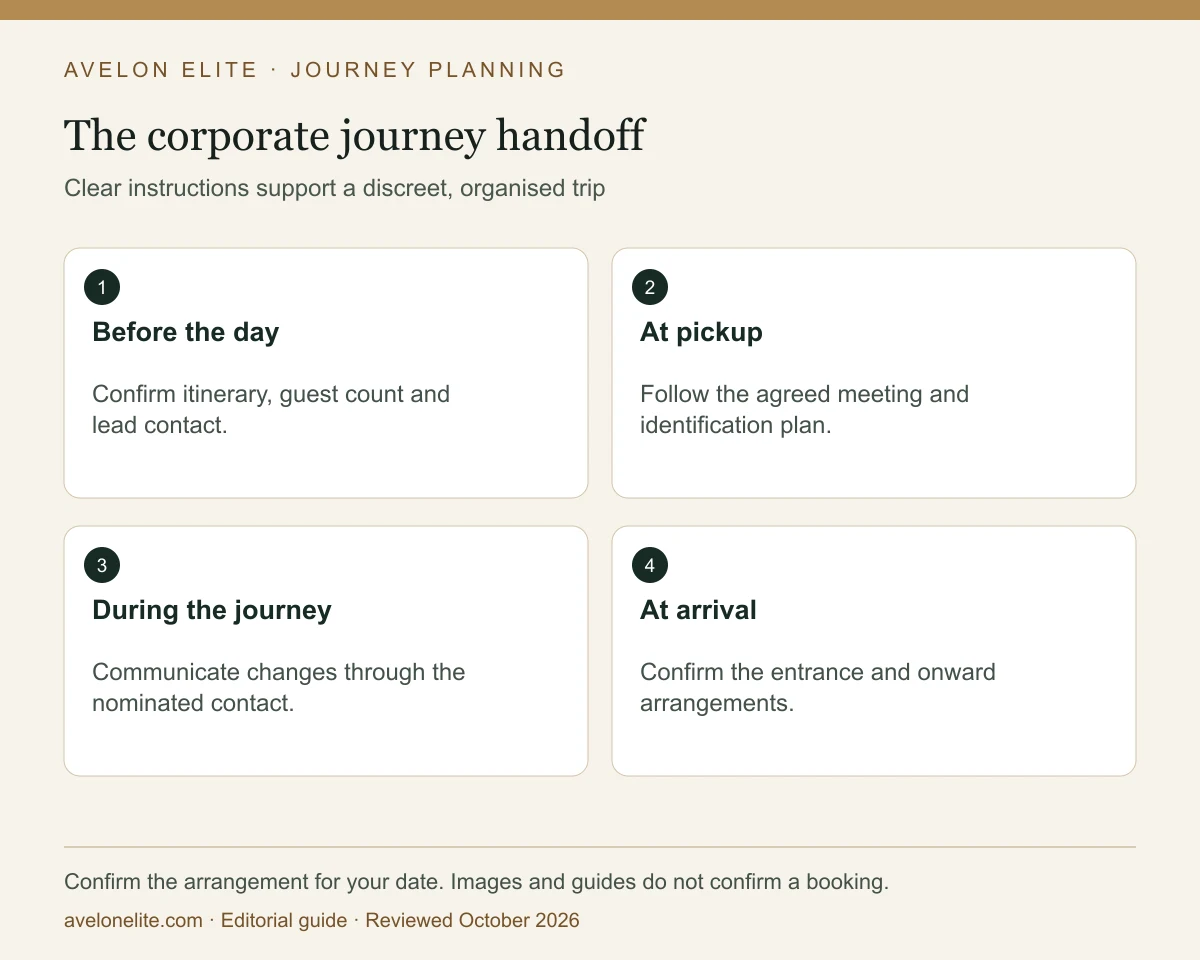
Before the day: Confirm itinerary, guest count and lead contact. At pickup: Follow the agreed meeting and identification plan. During the journey: Communicate changes through the nominated contact. At arrival: Confirm the entrance and onward arrangements.
Use the ride for work you can pause, such as reviewing an agenda or outlining questions for the next meeting. Give confidential discussions, screen sharing and deadline-critical calls a separate slot at a suitable location. A quiet cabin can make a call easier to hear, and people in the vehicle may still hear your side of it.
Swipe to compare all columns →
| Work you have planned | How to prepare | How to handle interruptions |
|---|---|---|
| Agenda review or routine notes | Save employer-permitted materials in advance and mark a point where you can pause. | Finish at the venue if you need to spread out papers or open information other passengers should not see. |
| Routine call or an online task | Use headphones if appropriate, keep your voice low and prepare a task you can continue offline. | Take the call at the destination if a signal drop or interruption would affect the meeting. |
| Confidential call or screen sharing | Reserve a private room at the destination and follow your employer’s policy. | Allow time for check-in and setup at the venue before the call starts. |
Ask about any essential charging connection, equipment or quiet preference when requesting the ride. Wait for the actual booking confirmation. If you need internet access, follow your employer’s policy. The NSA’s wireless security guidance recommends avoiding public Wi-Fi in favor of a secured personal or company hotspot. Download approved material before pickup so your work can continue offline if coverage drops.
While the car is moving, stay seated and keep your seat belt fastened, including in the rear seat, as recommended by NHTSA’s seat belt guidance. Keep bags together and follow the chauffeur’s stowage instructions. Pause work when you need to confirm a pickup, entrance or itinerary change through the agreed channel.
Example. Two colleagues traveling to a Midtown office can review a non-sensitive agenda and agree on their opening questions in the car. They can schedule their confidential discussion after building check-in, once they reach a private room. An assistant coordinating several appointments can use the financial roadshow guide to plan that transition, or check the hourly chauffeur guide if waiting time at the venue is part of the request.
Review what the quoted arrangement covers, including the route or booked duration, applicable waiting charges, extra stops, tolls and other stated costs. Ask about cancellation and change terms before accepting the booking. Obtain the billing details required by your organisation and confirm how the invoice will be issued.
For several passengers or vehicles, keep one itinerary version with a clear date or revision note. When something changes, send the revised detail rather than an ambiguous instruction such as “use the new location.” A full address and a named contact help the team review the change.

When the details are settled, open online reservations or contact Avelon Elite to discuss the itinerary. A request becomes a booking only through the applicable confirmation process.
Include the travel date, requested pickup time, full addresses, passengers, luggage and any planned stops. Add a suitable journey contact and identify any appointment that has a fixed arrival time.
Ask how changes are handled before booking. A new destination, additional waiting or extra stop may affect availability and price. Send the revised details through the agreed contact channel and wait for confirmation.
Start with passenger and luggage needs, then choose a preferred category. Ask the operator to confirm the available vehicle and configuration rather than relying on a model name to determine capacity.
No. Request any essential amenity or privacy requirement and review the actual confirmation and terms. A vehicle category does not establish a particular connection, equipment specification or absolute confidentiality guarantee.
This guide focuses on communication and conduct for an individual corporate booking. For the meeting-by-meeting schedule, building access and change control of a multi-stop day, use the financial roadshow planning guide.
Avelon Elite Chauffeur Dispatch
From executive airport arrivals at JFK, LGA, and EWR to private tarmac transfers at Teterboro (TEB), our white-glove chauffeurs ensure seamless, punctual transit.
More from the Blog
Hourly · 8 min readCoordinate an as-directed chauffeur itinerary with one approver, exact next-stop instructions, passenger and luggage updates, and a confirmed final return.
Read article→ Hourly · 8 min read
Plan a New York shopping itinerary with store appointments, entrance details, purchases and luggage, clear pickup updates and a confirmed journey home.
Read article→ Hourly · 8 min read
Plan hourly chauffeur travel in New York around the booked start, time at stops, final return and extra-time terms. Use a practical time ledger.
Read article→