
 Hourly · 8 min read
Coordinating an As-Directed Chauffeur Itinerary
Coordinate an as-directed chauffeur itinerary with one approver, exact next-stop instructions, passenger and luggage updates, and a confirmed final return.
Read article→Plan hourly chauffeur travel in New York around the booked start, time at stops, final return and extra-time terms. Use a practical time ledger.
MOE
Nov 4, 2026

Define the whole itinerary, from the first collection to the final movement.
“We need a car until one” sounds precise until the meeting itself finishes at one. There may still be a reception exit, a return collection and a journey to the final destination. Flexible hourly chauffeur hire works better when the request identifies what must happen within the booked period, rather than giving only an appointment's end time.
This guide explains how to define the time and scope of a New York City hourly enquiry. It focuses on the start and finish of the arrangement, time away from the vehicle and how to handle an extension. The written confirmation determines the booking terms; flexibility should be described through that agreement.
Begin with the date, requested first collection and the final movement you need. If you want to return to a hotel after an appointment, name that destination in the original request. “Finish at the office” and “collect us after the office visit and return us to the hotel” describe different scopes.
Then ask how the proposed time is measured. Which event starts the chargeable period? Which event ends it? Does the calculation include travel before the first passenger collection or after the final drop-off? Do not assume that pickup-based or garage-based charging applies. A clear answer should connect the quote to the journey you described.
Keep the requested service window and the quoted charging basis visible together. An assistant might record the intended passenger movements accurately while overlooking a different start or end condition in the proposal. Resolve that difference before accepting, rather than discovering it when the day overruns. The hourly chauffeur service page outlines the information to send with an enquiry.
Illustration only: suppose you request service from 09:00 to 13:00 and your meeting is scheduled to finish at 13:00. These times illustrate a planning problem; they are not a quoted booking period, a minimum hire or a driving-time estimate.
When the meeting ends, you may still need to collect belongings, leave the building and reach the agreed pickup point. The return collection and final drop-off occur afterwards. The original request therefore needs review if you expect it to include that later return. A meeting ending at the requested finish time does not, by itself, establish coverage for the remaining journey.
A time ledger for the illustrative request
Swipe to compare all columns →
| Event | What it describes | Question to settle |
|---|---|---|
| 09:00 requested start | The intended beginning of the passenger's arrangement. | What event actually starts the quoted charging period? |
| 13:00 meeting finish | The appointment ends, not necessarily the transport. | Is the later return included within the proposed scope? |
| Passenger ready for collection | The traveller can leave from the agreed meeting point. | How will readiness and any delay be communicated? |
| Return pickup | The next passenger movement begins. | Is this part of the hourly booking or a separately confirmed transfer? |
| Final drop-off | The passenger reaches the last agreed destination. | How does this relate to the quoted end condition? |
The useful correction is not to add an arbitrary buffer to every request. Send the actual final movement and have the proposed duration reviewed against it. For several business appointments, the financial roadshow planning guide addresses the meeting sequence; this time ledger addresses what the booking must cover.
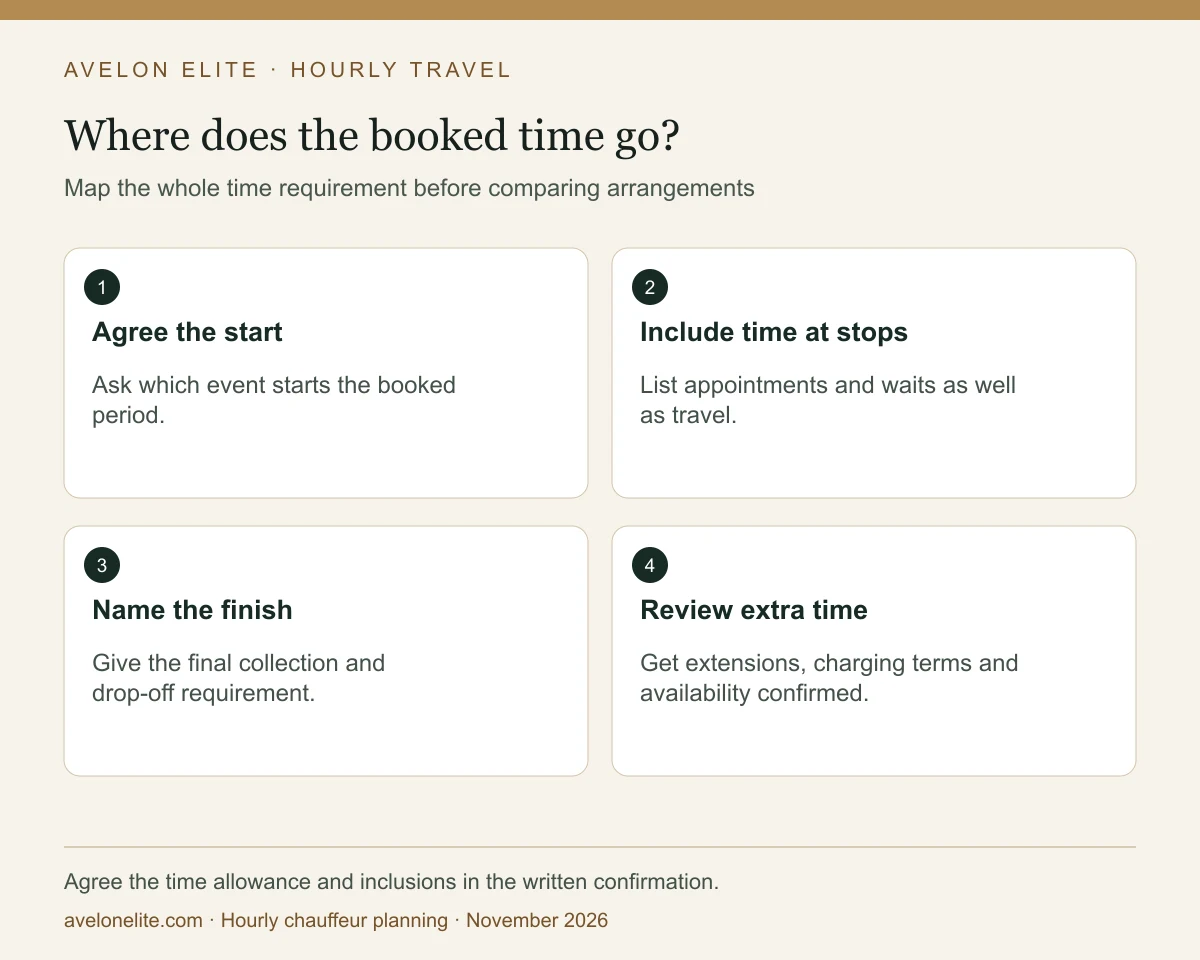
Agree the start: Ask which event starts the booked period. Include time at stops: List appointments and waits as well as travel. Name the finish: Give the final collection and drop-off requirement. Review extra time: Get extensions, charging terms and availability confirmed.
The interval between outward and return journeys is a decision, not empty space. You might need two separate movements or an arrangement that includes time between them. State that need directly so proposals can be compared on the same basis.
Describe the request before choosing its label
Swipe to compare all columns →
| Your requirement | What to describe | What to clarify |
|---|---|---|
| One journey to a destination | Origin, destination and required collection. | Whether a point-to-point proposal covers the complete request. |
| Outward journey and later return | Both movements and the period between them. | Separate transfers or an hourly arrangement, including what happens in the gap. |
| Time at several locations | The intended period, essential stops and final destination. | Booked time, geographic scope and treatment of changes. |
An event's uncertain finishing time deserves the same attention. “Collect after the gala” does not define a collection window or an open-ended reservation. The gala transport guide covers the event plan; use the quotation questions below to establish the return arrangement.
Tell the team when you expect to be inside a building, at lunch or at an appointment. Ask how that interval is treated within the proposed booking. Being away from the vehicle does not establish that the chargeable period pauses. Equally, a long gap does not automatically establish that one continuous hourly booking is the appropriate choice.
An hourly arrangement also does not reserve a curb. NYC DOT's parking guidance states that waiting is not permitted under No Parking, No Standing or No Stopping restrictions. Its summary allows passenger collection and drop-off under the first two categories, but not under No Stopping. The actual location remains subject to posted signs and applicable restrictions. Discuss the practical return pickup rather than assuming the vehicle can remain outside the appointment.
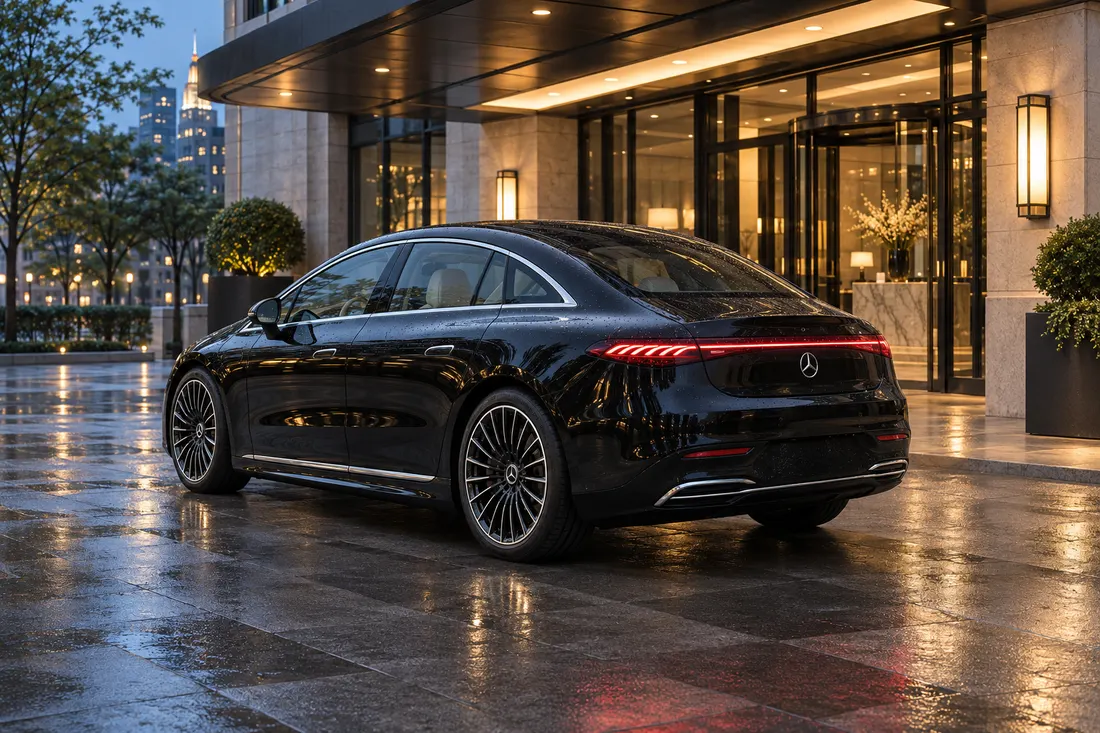
Keep the vehicle request connected to the period and purpose. For example, review the 2026 Mercedes-Benz EQS option if it suits the party, but do not infer charging terms or onboard amenities from the photograph. A change of vehicle request is also a change to review, rather than a substitute for defining the time correctly.
Use the same complete request when reviewing proposals. A headline hourly figure cannot explain a minimum period, a distance boundary or the treatment of additional time. Obtain answers that relate to your requested date and journey.
Quotation questions that make the booking boundaries clear
Swipe to compare all columns →
| Topic | Ask before confirming |
|---|---|
| Start and end | Which events begin and end chargeable time? Is any travel outside the passenger movements included? |
| Minimum and increments | Is there a minimum period, and how are partial periods or additional time calculated? |
| Stops and waiting | Which stops and intervals away from the vehicle does this proposal cover? |
| Distance and area | Are there distance allowances, geographic limits or conditions on the final destination? |
| Additional costs | How are parking, tolls and other stated additions treated? |
| Extension | Who approves extra time, how is availability reviewed and when is a revised arrangement confirmed? |
| Changes and cancellation | What terms apply to shortening, rescheduling or cancelling the booking? |
If an appointment runs late, send the consequence as well as the update: the expected passenger-ready time, the return still required and the person authorised to approve a change. “Meeting delayed” leaves the transport requirement unresolved.
Use the contact channel in the confirmation. Ask for review of the revised scope and any effect on price; an extension depends on the arrangement and availability. A message sent, a read receipt or a conversation about a possible stop is not the same as a confirmed extension. Share the final agreed update with the traveller and booking approver so both work from the same end condition.
Only if it accurately describes the arrangement you need. Include readiness, return collection and final destination when requesting transport after the meeting.
Do not assume so. Ask which event starts the quoted period and whether travel before collection or after drop-off forms part of the calculation.
That depends on the confirmed minimum period and amendment terms. Check the treatment of a shortened booking before relying on a reduction.
Raise it through the agreed contact. The proposed stop may affect distance, area, destination or the final movement, even when the clock appears to leave time.
No extension should be treated as settled until it is confirmed through the agreed process. Report the revised requirement and obtain the resulting arrangement.
Start with the first collection, time at stops and final movement, then explore your hourly booking. If the end time or scope needs discussion, send the full request to Avelon Elite before relying on an open-ended plan.
Avelon Elite Chauffeur Dispatch
From executive airport arrivals at JFK, LGA, and EWR to private tarmac transfers at Teterboro (TEB), our white-glove chauffeurs ensure seamless, punctual transit.
More from the Blog
Hourly · 8 min readCoordinate an as-directed chauffeur itinerary with one approver, exact next-stop instructions, passenger and luggage updates, and a confirmed final return.
Read article→ Hourly · 8 min read
Plan a New York shopping itinerary with store appointments, entrance details, purchases and luggage, clear pickup updates and a confirmed journey home.
Read article→ Fleet · 7 min read
Plan New York group chauffeur travel with clear meeting points, passenger and luggage counts, a lead traveller and a realistic plan for changes.
Read article→