
 Hourly · 8 min read
Coordinating an As-Directed Chauffeur Itinerary
Coordinate an as-directed chauffeur itinerary with one approver, exact next-stop instructions, passenger and luggage updates, and a confirmed final return.
Read article→Plan New York group chauffeur travel with clear meeting points, passenger and luggage counts, a lead traveller and a realistic plan for changes.
MOE
Nov 3, 2026

Bring the complete group and agreed luggage load together before collection.
Six people can share a destination without being ready to leave together. One colleague is checking out, another is collecting a suitcase and the rest are waiting beside a different hotel entrance. An executive van helps only when the people, bags and meeting instructions form one workable departure.
This guide explains how to assemble a group for chauffeur travel across New York: choose an indoor gathering place, distinguish it from the vehicle meeting point and give one lead traveller responsibility for the final readiness update. It is practical planning advice; the booking confirmation defines the actual service.
A useful starting question is: can everyone named in this movement leave from the same agreed place with their belongings? A shared calendar invitation does not answer that question. Before an office collection, establish whether visitors still need reception clearance. Before a hotel departure, identify who must finish checkout or retrieve stored bags.
Name a lead traveller who will be with the group and reachable through the agreed contact channel. The booking approver may be an assistant elsewhere; that person handles requests affecting the itinerary, price or scope. Keep those roles distinct so a missing passenger does not trigger several contradictory instructions. The corporate chauffeur protocol guide covers the wider business communication plan.
Use observable readiness rather than an optimistic estimate
Swipe to compare all columns →
| Stage | What the lead traveller checks | What to communicate |
|---|---|---|
| Gathering | Who is still at reception, checkout or baggage collection? | Which part of the party is missing; do not call the whole group ready. |
| Assembled | All travellers and the complete luggage load are together. | Actual passenger and bag counts, plus any difference from the booking. |
| Collection instructions understood | Everyone knows the confirmed vehicle meeting point. | Acknowledge the current instructions rather than choosing another curb. |
| Boarding | The party follows the agreed approach and boarding instructions. | Raise a missing person or load problem before the vehicle departs. |
The assembly point is where the group gathers: for example, a specified lobby area or reception desk agreed with the building. The vehicle meeting point is where the pickup can take place. They need not be identical. A building's street address may cover several entrances, and an attractive front door may not be an appropriate place for a vehicle to wait.
NYC DOT's parking guidance distinguishes waiting from passenger collection. Its summary prohibits waiting under No Parking, No Standing and No Stopping restrictions. Passenger pickup and drop-off are permitted under the first two categories, but not under No Stopping. The posted signs and other applicable restrictions still govern the actual location. Assemble the party before approaching the agreed pickup point; do not build the plan around a vehicle holding a restricted curb.
At JFK, the airport states that terminal curbsides are for active collection and drop-off, with no parking beside the terminals. An indoor group rendezvous does not authorise a chauffeur to leave a vehicle at that curb. Use the booking's pickup instructions and report when the party has completed its required arrival steps. The JFK pickup guide explains the airport handoff in more detail.

The offered 2026 Mercedes-Benz Sprinter limit is six passengers and four typical suitcases, excluding the chauffeur. A party of six with four typical cases fits those stated numerical limits, but case dimensions, equipment and the required configuration still matter. List cabin bags and unusual items too; a suitcase count alone does not describe every load.
Six travellers with six cases present a different request. The extra cases do not become suitable because the passenger count remains six. Send the revised load for review before relying on the original arrangement. Do not use a passenger seat as an assumed luggage allocation.
That search phrase can blur whether the chauffeur is included. Avelon Elite's offered Sprinter arrangement is for six passengers plus the chauffeur, with four typical suitcases. Seven passengers require another arrangement confirmed by the team; this guide does not promise that an additional or larger option is available.

Replace “we are nearly there” with a short, factual update through the agreed channel: “All six travellers are together at the agreed lobby assembly point with four cases. We have the collection instructions.” Send this only when it is true. Add a relevant issue, such as a changed bag count, rather than sharing unrelated work or personal information.
A readiness message does not change the booked collection time or summon a vehicle before its confirmed arrangement. If the party is early or late, distinguish its current status from the request: “We are assembled early; can the booking contact review whether an earlier collection is possible?” Wait for confirmation before moving the group to a new location or treating a proposed time as settled.
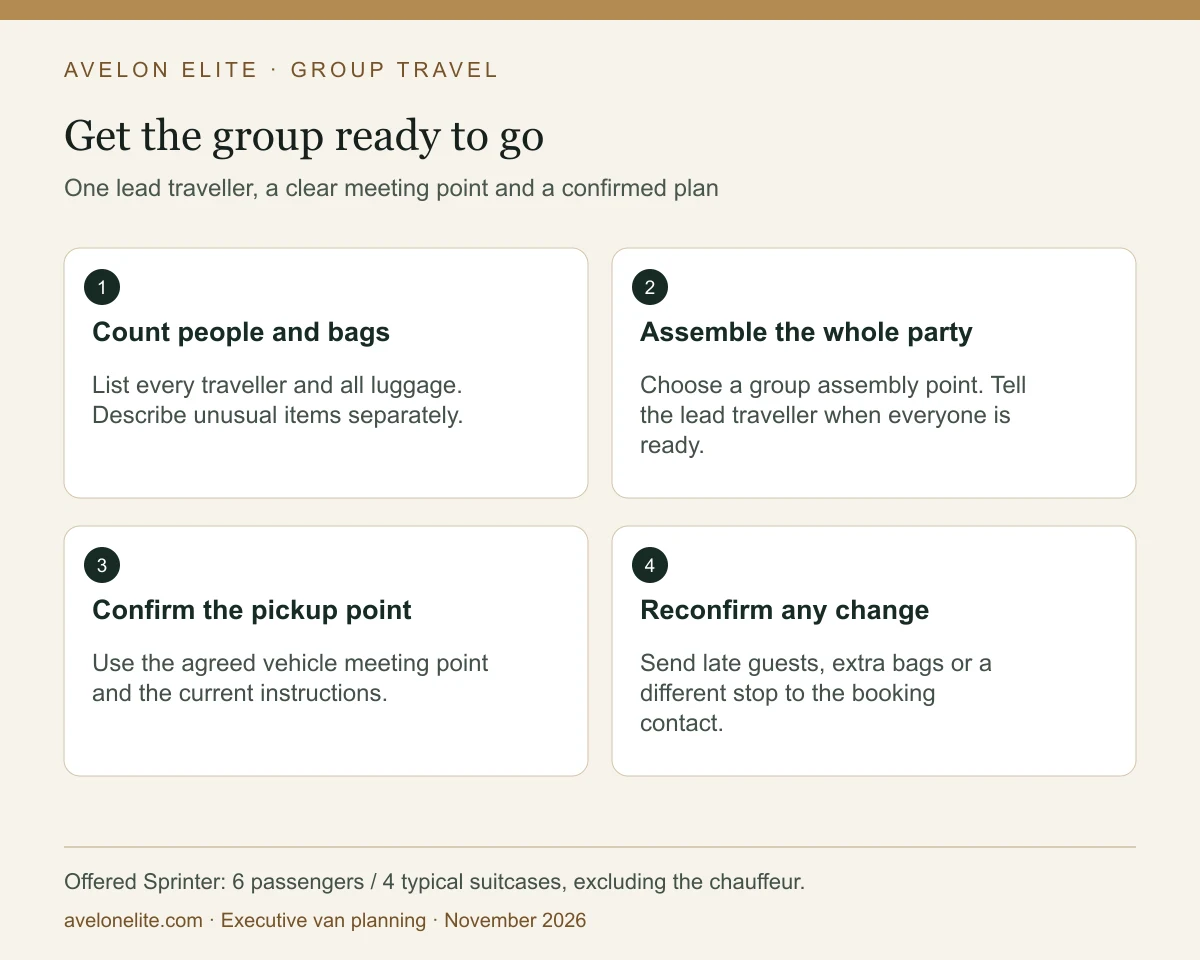
Count people and bags: List every traveller and all luggage. Describe unusual items separately. Assemble the whole party: Choose a group assembly point. Tell the lead traveller when everyone is ready. Confirm the pickup point: Use the agreed vehicle meeting point and the current instructions. Reconfirm any change: Send late guests, extra bags or a different stop to the booking contact.
When plans change, identify the affected movement rather than updating only the group chat. The approver should receive the changed requirement; the lead traveller should receive the resulting confirmed instructions.
Changes that require a revised group plan
Swipe to compare all columns →
| What changes? | Useful update | What remains unsettled? |
|---|---|---|
| Six passengers, four cases becomes six passengers, six cases | Send the full revised luggage list and dimensions where relevant. | Suitability of the proposed arrangement. |
| A seventh passenger joins | State seven passengers, excluding the chauffeur. | A team-confirmed alternative; do not assume another vehicle is available. |
| Two travellers cannot leave with the other four | Identify each party's ready time, bags and destination. | Separate confirmed plans for the two groups. |
| The building changes the exit | Send the exact entrance instruction to the journey contact. | A practical collection point reviewed with the transport team. |
Separate vehicles or departures do not guarantee synchronised arrival. Give each group its own lead contact and usable instructions. For travellers arriving on different flights, do not assume the first party's airport booking includes waiting for the second. Explain both requirements through the airport transfer enquiry. If the itinerary includes time between movements, review the hourly service scope rather than assuming an outward transfer covers it.
Keep the final version short enough to consult on a phone. Replace proposed details with confirmed ones, and withdraw superseded instructions from the active group message.
Final group departure brief
Swipe to compare all columns →
| Field | Include |
|---|---|
| Journey | Date, confirmed collection time, origin and destination. |
| Assembly | Named indoor gathering point and the lead traveller. |
| Vehicle meeting | The agreed collection instructions, separately from the lobby rendezvous. |
| Load | Passenger count excluding chauffeur, suitcases and additional items. |
| Contacts and changes | Journey contact channel, booking approver and how revisions will be confirmed. |
No. It reports the group's status. An earlier or later collection remains a requested change until confirmed through the booking contact.
Choose an appropriate assembly place with the building or venue. Keep gathering separate from the vehicle's collection instructions, and avoid sending people to an assumed roadside waiting point.
No. Its offered limit is six passengers, excluding the chauffeur, and four typical suitcases. Ask the team to review a different arrangement for seven passengers.
Yes. Include additional bags, pushchairs, mobility equipment or other bulky items so the suitability review considers the actual load.
Report who is missing and ask the approver to review the options. Do not split the party or alter the destination on the assumption that the original confirmation covers both journeys.
With the party, load and meeting instructions settled, plan your group ride. For a changed load or a departure requiring more coordination, send the complete group brief for review.
Avelon Elite Chauffeur Dispatch
From executive airport arrivals at JFK, LGA, and EWR to private tarmac transfers at Teterboro (TEB), our white-glove chauffeurs ensure seamless, punctual transit.
More from the Blog
Hourly · 8 min readCoordinate an as-directed chauffeur itinerary with one approver, exact next-stop instructions, passenger and luggage updates, and a confirmed final return.
Read article→ Hourly · 8 min read
Plan a New York shopping itinerary with store appointments, entrance details, purchases and luggage, clear pickup updates and a confirmed journey home.
Read article→ Hourly · 8 min read
Plan hourly chauffeur travel in New York around the booked start, time at stops, final return and extra-time terms. Use a practical time ledger.
Read article→